Start with your project
Import supported ETS projects with a report of warnings and limitations. Continue in KNXBench’s own versioned format. Or start a new project from scratch.
.knxproj → .knxdb
 KNXBench
Independent KNX engineering · Alpha
Import projects. Work with devices and group addresses. See what the bus is saying. KNXBench brings your installation into a modern engineering workspace.
In your browser via Docker. Or natively on Linux.
Free to use
On your own instance
Project data with clear import reports
You know your installation. Your tools should help you understand it, not get in the way.
Import supported ETS projects with a report of warnings and limitations. Continue in KNXBench’s own versioned format. Or start a new project from scratch.
.knxproj → .knxdb
Topology, buildings, devices, group addresses and links in one workbench. With search, an inspector and undo/redo, so the next change stays understandable too.
Search · Inspector · Undo/redo
Observe telegrams over KNXnet/IP, inspect values and explore communication as a table or flow view. Individual messages become a picture you can follow.
Telegram monitor · Flow view
Short looks at the real application. Every recording uses fictional sample data, not somebody’s actual installation.
Add a device from the product catalog, assign a free address and link a communication object to a group address. Without jumping between five different tools.
A push button is selected, named and created with a free individual address in the sample house. Its first communication object is then linked to 0/0/2 “Kitchen light”. The recording uses zoom and time compression; it is not a real-time performance test.
The flow view brings senders, receivers and values together. Here it shows lights, blinds and temperature in the sample house, using synthetic telegrams and an optional CRT theme.
Synthetic telegrams make devices appear in the flow view: lights turn on and off, a blind goes down, and temperature and valve values change. The recording shows the real monitor component; no live bus is connected.
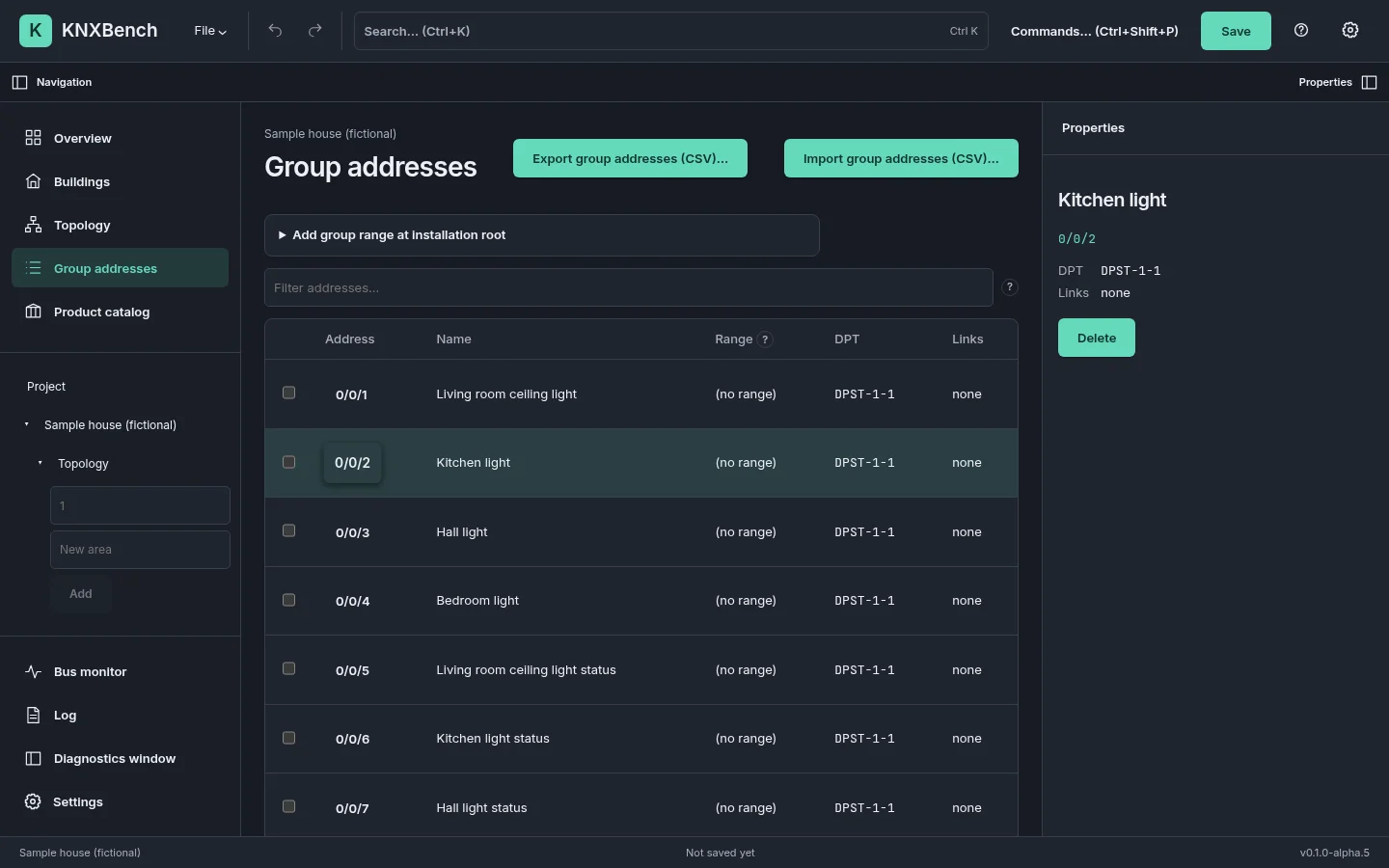
Filter group addresses, select an address and inspect its properties right beside it. A calm workspace for the details that matter.
The real app shows 15 group addresses from a fictional sample house. Filtering for “Kitchen” narrows the table; 0/0/2 is selected and its properties appear in the inspector. The filter is then cleared. API answers are offline demo data; no live server or bus is operated.
There are calm interfaces for focused work. And, when you feel like it, green phosphor and a small starship bridge. Themes, language packs and optional achievements add a little personality.
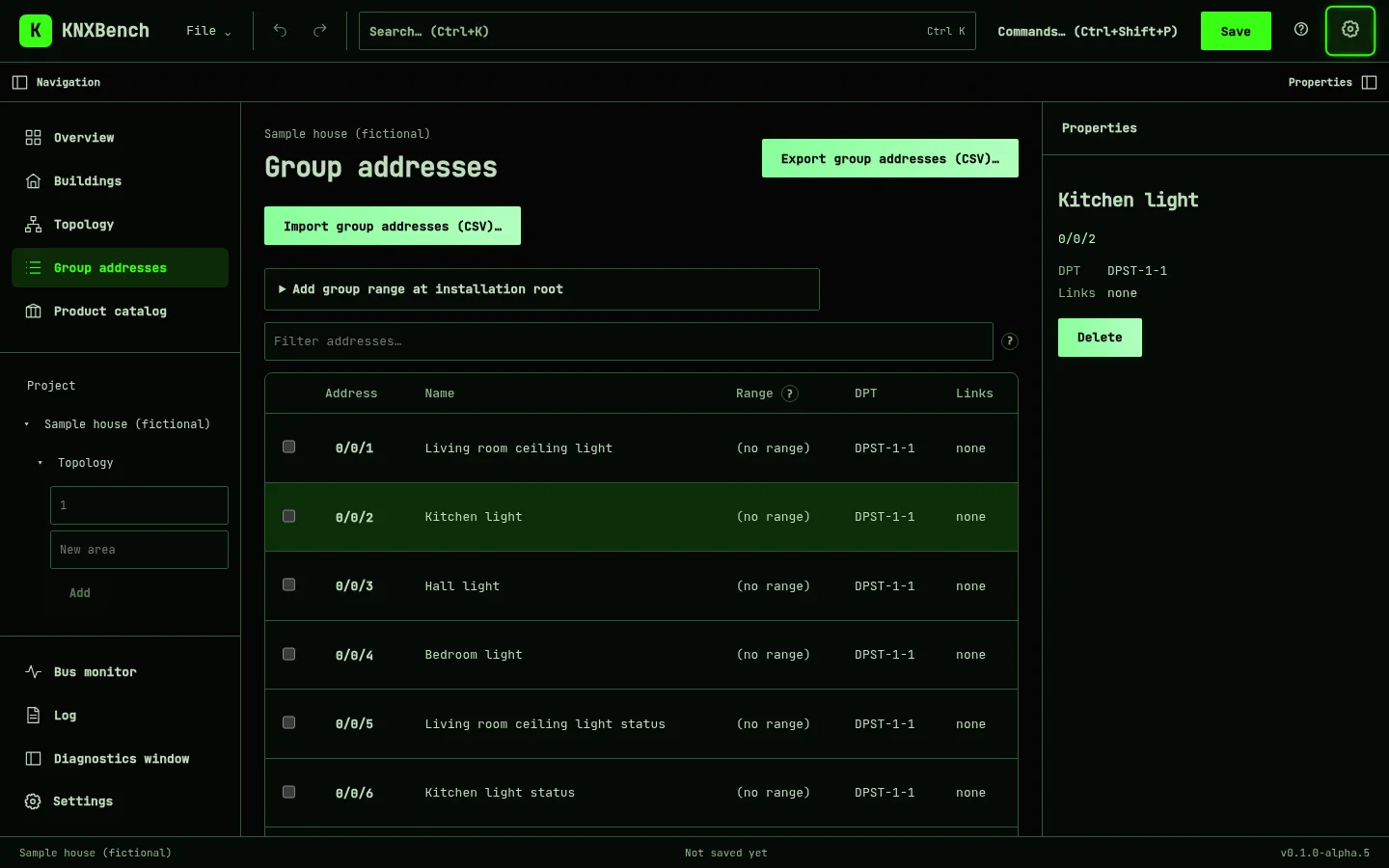
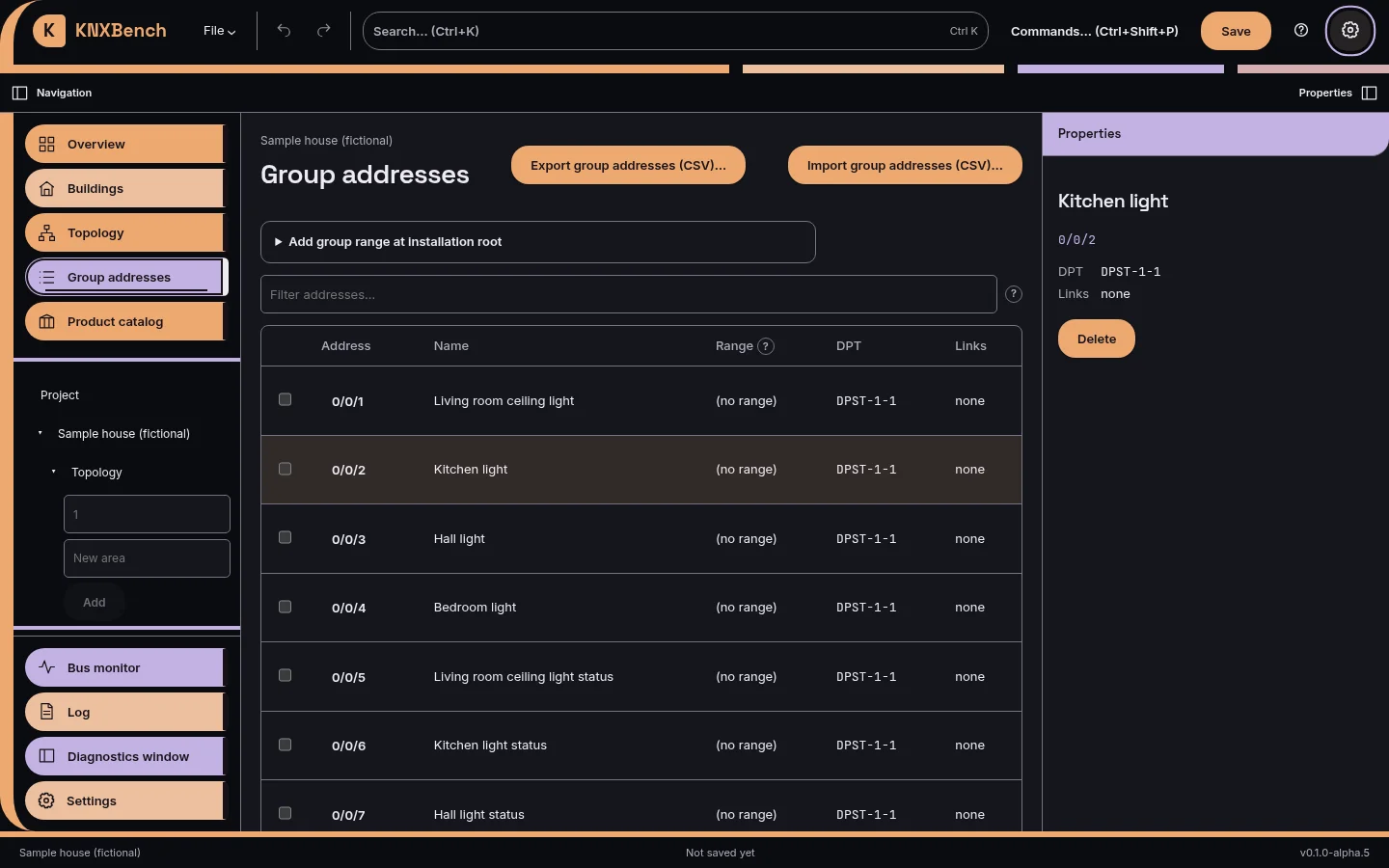
Optional. The underlying workbench stays the same. Screenshots: real app with offline demo data.
Evolution Story (English)
It began with wanting a KNX tool on Linux. Then came decisions, detours, AI assistants and rather a lot of “just one more thing”. The Evolution Story follows that path, with evidence and a slightly melancholy narrator.
Explore the Evolution StoryKNXBench is under active development. Try it, keep backups and check whether your project and devices fit the supported scope. Your feedback helps make the next version better.
Project work, product data and bus diagnostics are at the core. Import support and device operations have explicitly documented boundaries: not every format or device has the same level of support.
Try a copy first. Read the application’s guidance before hardware operations.
No account with us. No hosted demo. KNXBench runs on your own instance, so you try the real product.
Use the web app through a suitable Docker environment on your system. The container brings the interface and server together; you stay in control of your projects.
Live bus communication has additional networking requirements. Docker is not a promise of identical hardware connectivity on every host system.
The AppImage packages the desktop application for Linux. Find system requirements, alpha version information and installation guidance with the releases.
View Linux releasesChoose an alpha version, read the release notes and work with project copies.